

If you are a travel company looking for a China tour operator, choosing a good partner is about more than just comparing prices, checking itineraries, or testing response speeds. When you are managing logistics from overseas, what really matters on the ground is legal qualification, operational responsibility, financial protection, and accountability.
China runs a highly regulated tourism market. Any company that arranges tours, guides, hotels, transport, and ground services must have the proper business registration and tourism operation licenses.
Before you work with a China ground handler, DMC, or tour operator, it is always best to check whether they are legally registered and properly licensed. This simple verification is the smartest way to safeguard your clients and ensure smooth, reliable execution for every trip.
Legal Basis for a Qualified Travel Agency in China
A short legal reference for overseas travel agencies, corporate clients, and MICE partners
In the main legal basis of the Tourism Law of the People’s Republic of China.
Article 28 explains the basic conditions for establishing a travel agency, while Article 29 explains the business scope that a travel agency may operate.
Article 28: Basic Requirements for Establishing a Travel Agency
According to Article 28 of the Tourism Law of the People’s Republic of China, a travel agency that solicits, organizes and receives tourists, and provides tourism services, must meet legal establishment conditions, obtain approval from the tourism authority, and complete business registration according to law.
Article 28 sets out the following requirements:
- a fixed business premises;
- necessary business facilities;
- registered capital that meets the required standard;
- necessary management personnel and tour guides;
- other conditions required by laws and administrative regulations.
This means that a qualified travel agency in China is not only a company with a general business license. It must also be approved for travel agency operations. In practice, the key document is the Travel Agency Business Operation Permit.
Article 29: Business Scope of a Travel Agency
Article 29 of the Tourism Law explains the business scope of travel agencies.
According to this article, travel agencies may operate tourism services such as domestic tourism, inbound tourism, outbound tourism, border tourism and other tourism-related business.
However, outbound tourism and border tourism require the corresponding business operation permit. This is important because not every travel agency in China is automatically allowed to operate every type of tourism business.
For overseas partners, this means the company’s approved business scope should match the actual services it provides. For example, if a Chinese travel agency receives international visitors and arranges ground handling services in China, its qualification should cover relevant travel agency operations, especially inbound tourism services.
Supporting Rules under the Travel Agency Regulation
In addition to the Tourism Law, the Travel Agency Regulation provides more detailed rules for travel agency establishment and approval.
For domestic tourism and inbound tourism business, the regulation requires the applicant to have a fixed business place, necessary business facilities, and registered capital that meets the required standard.
The regulation also explains the application process. The applicant must submit required documents to the relevant tourism authority. After review and approval, the authority issues the Travel Agency Business Operation Permit. The company must then complete business registration according to law.
Why This Matters for Overseas Partners
For overseas travel agencies, corporate clients, schools, event organizers and MICE partners, checking a Chinese travel agency’s qualification is a practical risk-control step.
A legally qualified Chinese travel agency should be able to provide or show:
- business registration information(license);
- Travel Agency Business Operation Permit with approved business scope;
- legal company name behind its brand or website;
- service quality deposit monitored by China Tourism Administration;
- annual company insurance.
The company name, permit information and service scope should be consistent. This helps partners confirm that they are working with a legally established China tour operator.
Summary of Key Legal Articles
Legal Basis | Article / Term | Main Meaning |
Tourism Law of the People’s Republic of China | Article 28 | Basic establishment conditions for a travel agency. |
Tourism Law of the People’s Republic of China | Article 29 | Business scope of travel agencies and permit requirements for certain services. |
Travel Agency Regulation | Relevant establishment provisions | Detailed requirements, approval procedures and permit issuance. |
For international partners, the most important documents to check are the company’s business registration information and its Travel Agency Business Operation Permit, Annual Company Insurance. These documents help confirm whether the Chinese travel agency is legally established, properly licensed and qualified to provide you agreed travel services.
Legal Reference
- Tourism Law of the People’s Republic of China, Article 28 and Article 29.
- Travel Agency Regulation of the People’s Republic of China, relevant provisions on travel agency establishment and operation permits.
- Official source provided:
https://www.gov.cn/flfg/2013-04/25/content_2390945.htm
https://zwgk.mct.gov.cn/zfxxgkml/zcfg/xzfg/202012/t20201204_905508.html
Why legitimacy matters when choosing a China tour operator?
A China tour program involves many practical responsibilities. The local operator may handle hotel bookings, attraction tickets, transport, guides, meals, domestic train tickets, domestic flights, emergency support, and client communication during the trip.
If the local company is not properly licensed, travel agents may face risks such as unclear responsibility, weak supplier control, poor complaint handling, or difficulty protecting client rights when problems occur.
A legitimate China tour company should be able to show its basic company documents and explain its legal operating status clearly.
1. Business License with Unified Social Credit Code
A legally registered travel company in China should have a business license.
This business license includes the company’s official Chinese name, registered address, legal representative, business scope, registration authority, and Unified Social Credit Code.
The Unified Social Credit Code is the company’s official identification number in China. It is used for government registration, tax, banking, contracts, and legal business activities.
For overseas travel agents, this is the first document to check. A company that cannot provide a valid business license should be treated carefully.
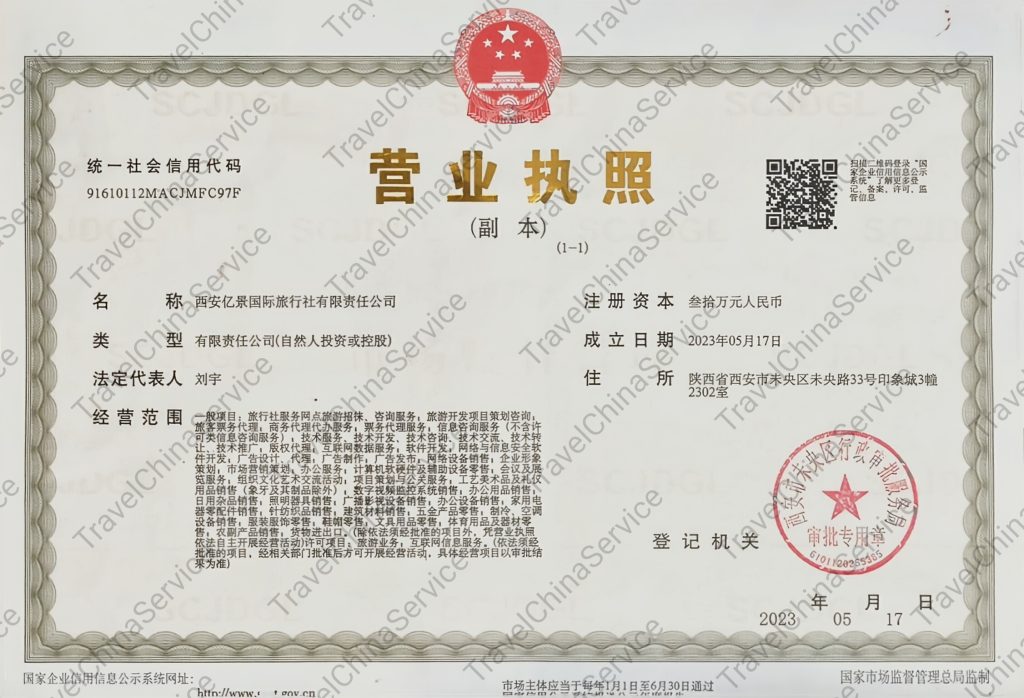
Business License of TravelChinaService
2. Travel Business Operation License
In China, a company that legally operates travel agency business should have a Travel Agency Business Operation License.
This license is important because normal business registration alone does not necessarily mean the company is qualified to operate travel agency services.
A licensed one can legally organize and arrange tourism services according to its approved business scope. For inbound travel services, you should check whether the company is qualified to handle international visitors and China ground arrangements.
When verifying a China tour company, you could ask for a copy of the travel agency operation license and confirm that the company name matches the business license.
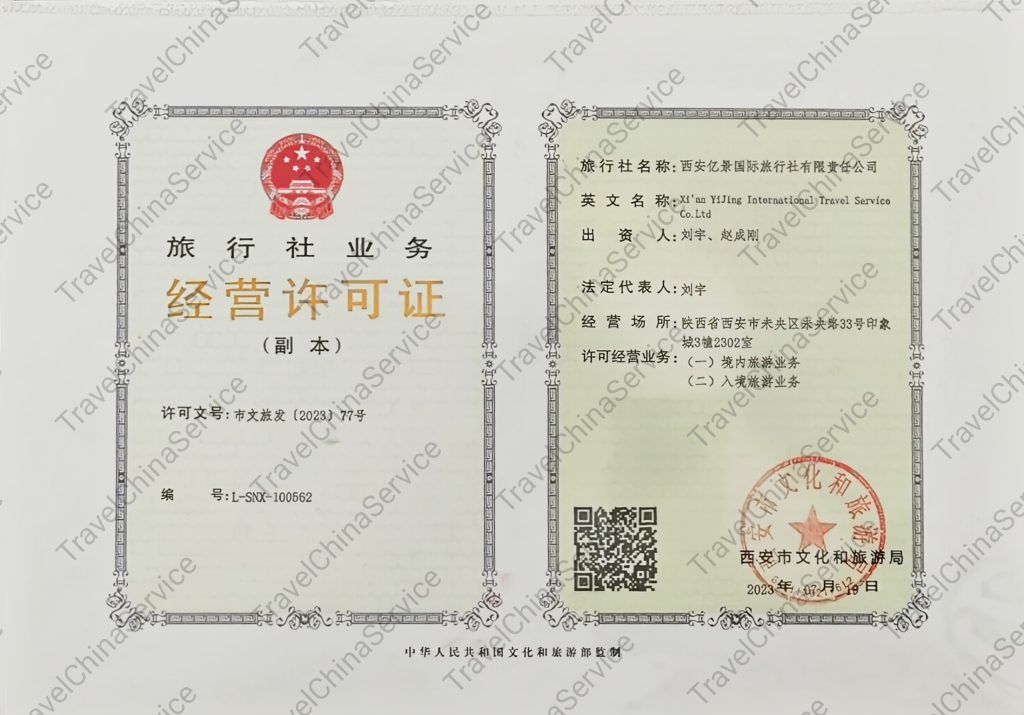
Travel Agency Business Operation Permit of TravelChinaService
3. International Travel Operation Qualification
For companies handling international travel-related services, international travel operation qualification is an important sign of proper tourism authorization.
This is especially important, if you are sending clients to China. The local partner should be able to explain whether it is qualified to receive international visitors, arrange China inbound travel services, and operate as a local ground service handler.
You should avoid working with individuals or informal teams that do not hold proper travel agency qualifications, even if their prices look attractive.
4. Annual company insurance
A responsible China tour company should maintain proper company insurance or travel service-related insurance arrangements.
Insurance is part of risk management. It does not replace careful operation, but it helps show that the company understands its responsibility when handling travelers.
For travel partners, make sure that you ask whether your China partner has annual company insurance or travel agency liability insurance. This can be especially important for group tours, senior travelers, student groups, incentive groups, and customized programs involving multiple cities.
5. Service Quality Deposit
China’s travel agency system includes a service quality deposit requirement.
This deposit is usually placed in a designated bank account according to tourism regulations. It is connected with travel service quality and tourist rights protection. The purpose is to support better compliance with tourism law and provide a regulated mechanism when certain serious service problems or legal responsibilities arise.
For overseas travel agents, you need to know that this is an important trust signal. Because it shows that the company is not just a casual service provider, but part of the regulated travel agency system in China.
The exact deposit amount and requirement may depend on the company’s business scope and current regulations, so agencies should check the latest official rules when needed.
6. The company name should match across all documents
When reviewing documents, you should check whether the company name is consistent.
The name on the business license, travel agency license, bank account, contract, invoice, and official communication should match or have a clear legal relationship.
If the website uses one name, the contract uses another name, and the payment account belongs to a third party, this should be checked carefully before payment.
When working with a China tour operator, clear company identity helps avoid confusion and reduces operational risk.
7. Contracts should be signed with the licensed company
You should make sure contracts are signed with the legal company, not only with an individual sales person or informal contact.
A proper contract should include company names, service scope, itinerary, inclusions and exclusions, payment terms, cancellation terms, responsibility clauses, emergency contact details, and dispute handling method.
A written agreement protects both sides. It also makes the operation clearer when changes happen during the tour.
8. Be careful with unusually low prices
Low price alone does not always mean risk, but unusually low pricing should be checked carefully.
A China tour has real costs: hotels, vehicles, guides, attraction tickets, meals, train tickets, domestic flights, and operation support. If a quotation is much lower than market level, travel agents should understand why.
Possible reasons may include distant hotels, lower meal standards, unlicensed guides, hidden shopping stops, unclear inclusions, or missing services.
A trustworthy China tour operator should be able to explain the quotation clearly.
9. Check whether the company has real local operation ability
Licenses are important, but operation ability is also important.
Make sure you check whether the company can provide practical local support, including guide arrangements, transport coordination, ticket reservations, hotel communication, emergency handling, and itinerary adjustment.
For complex multi-city China programs, the local partner should understand how to coordinate services across different destinations.
A legitimate company should not only sell the itinerary. It should also be able to operate it.
For long-term cooperation, document checking is normal and professional. A legitimate China tour company should understand this request.
When choosing a China tour company, overseas travel agents should be careful. A professional website, fast reply, or attractive itinerary is not enough. The company should also have legal registration, proper tourism operation qualification, insurance awareness, a regulated service quality deposit, and clear company identity.
Working with a legitimate China travel operator helps protect both the travel agency and the final clients. It also makes communication, payment, responsibility, and on-tour support clearer.
Before sending clients to China, you need to check who you are working with.
In China travel operations, trust should be built on documents, compliance, communication, and real ground handling ability.